
By John Bowman
Some bands commemorate twenty years by looking backward.
They remaster the old records, reopen the archives and assemble a victory lap from familiar photographs, familiar stories and familiar songs. Motionless in White have never been particularly interested in standing still long enough to become a museum exhibit.
On Decades, they celebrate survival by making as much noise as possible.
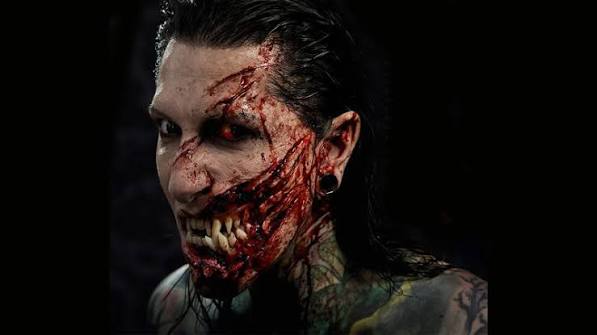
Released July 17 through Roadrunner Records, the band’s seventh studio album does not attempt to summarize its career neatly. Instead, it throws nearly every version of Motionless in White into the same room: the industrial machinery, metalcore violence, arena-sized choruses, gothic romanticism, nu-metal swagger, electronic experimentation and emotional vulnerability. Produced by Drew Fulk and Justin DeBlieck, the record was deliberately positioned as a collision between the band’s past, present and future rather than a retreat into nostalgia.
The result is ambitious, occasionally chaotic and unmistakably alive.
But Decades is not ultimately a monument to how long Motionless in White have survived.
It is a testament to how many people may have survived alongside them.
Still Here
The title track begins like a door being kicked off its hinges.
“Decades” is fast, confrontational and built around the refusal to become a relic. Chris Motionless sounds less interested in accepting congratulations than in challenging anyone who assumed longevity would make the band comfortable. The track’s hardcore urgency and violent rhythmic shifts establish an album that views twenty years not as a finish line, but as evidence that Motionless in White still have something to fight.
That defiance carries into “log_in//crash_out,” where mechanized electronics grind against down-tuned guitars and enormous melodic hooks. It feels like the digital-age descendant of the industrial textures that have long lived inside the band’s music: overstimulated, hostile and constantly flickering between human emotion and technological overload.
The electronics become one of Decades’ defining characteristics. At their best, they are not decoration. They create atmosphere, tension and momentum, allowing the record to move between nightclub neon, factory-floor aggression and cinematic darkness without abandoning its metallic foundation. At other moments, their near-constant presence causes individual songs to bleed together, particularly across the album’s middle stretch. That repetition is Decades’ greatest weakness, but it is also part of the risk the band has chosen to take.
Motionless in White could have created a safe anniversary record.
They chose experimentation instead.
Guests at the Funeral
“R.I.P.” introduces Skylar Grey into one of the album’s most immediately accessible moments. Her restrained delivery gives Chris Motionless room to perform with vulnerability rather than theatrical menace, and their voices meet inside a mournful, cinematic arrangement. The song exists in the emotional territory previously occupied by “Another Life” and “Masterpiece,” but it does not feel like a copy. It feels like another chapter in the band’s fascination with endings that refuse to remain buried.
“Fight Like Hell” then changes the temperature completely. Built from chunky guitars, martial momentum and a deliberately exaggerated nu-metal strut, it is equal parts battle cry and guilty pleasure. Its rap-inflected passages may divide listeners, but subtlety would defeat the purpose. This is Motionless in White embracing the oversized, sometimes ridiculous joy of heavy music without apologizing for it.
Corey Taylor’s appearance on “Playing God” provides the album’s most obvious collision of heavy-music generations. The song attacks the cruelty, dishonesty and manufactured outrage of online culture, with Taylor sounding genuinely venomous beside Chris Motionless. Rather than overshadowing the band, his presence reinforces its authority. Motionless does not sound like a vocalist standing beside one of his influences. He sounds like a peer meeting him in the wreckage.
“Playing God” will understandably attract headlines.
But the next song is where Decades reveals its heart.
When the Music Speaks Back
“All That I’ve Ever Known” initially appears to be another song about endurance.
Then the perspective begins to shift.
The lyrics can be interpreted as the voice of music itself addressing the listener. Rhythm becomes medicine. Volume becomes relief. A song becomes something capable of entering the body, finding the pain and remaining present when ordinary language has failed.
It is a striking reversal.
For years, listeners have told artists that their music saved them. “All That I’ve Ever Known” imagines what the music might say in return.
The song does not promise to erase trauma or magically repair a damaged life. It offers something more honest: companionship inside the darkness. It presents music as an interruption to isolation—a force that cannot fight every battle for someone, but can remind them they are not fighting entirely alone.
That distinction matters.
Music is not therapy, medication or crisis intervention. It should never be asked to replace professional care. But anyone who has survived a night by replaying the same song understands that art can create enough distance between a person and their pain to make one more breath possible.
Sometimes a song does not save your life by solving it.
Sometimes it saves your life by staying.
Sonically, “All That I’ve Ever Known” mirrors that tension. Electronic pulses create an almost clinical atmosphere before the song expands into something warmer and more human. Its dubstep-influenced disruption will be one of the album’s more divisive production choices, but even that rupture serves the song’s central idea: comfort does not always arrive gently. Sometimes it comes through distortion, impact and overwhelming volume.
Placed near the center of the album, the song changes the meaning of everything around it.
The title Decades no longer refers only to the years accumulated by the band. It refers to the private histories carried by its audience: the bedrooms, hospital rooms, long drives, panic attacks, breakups, relapses, recoveries and moments when headphones became temporary shelter.
Motionless in White are celebrating twenty years.
“All That I’ve Ever Known” quietly asks how many lives were lived during them.
Blood, Neon and the Dance Floor
After such emotional weight, Decades refuses to remain solemn.
“Blood Rave,” featuring Anthony Martinez of Dark Divine, transforms the record into a vampire nightclub. Electronic rhythms, melodic vocals and sudden bursts of aggression make it one of the album’s boldest experiments. It sounds less like a traditional metalcore track than something created for the precise moment when a gothic dance floor turns into a circle pit.
“Love at First Bite” continues the nocturnal atmosphere with grand piano, synth textures and an unapologetically playful concept. It is theatrical without becoming self-serious—a reminder that Motionless in White’s darkness has always contained humor, romance and camp alongside genuine anguish.
“Count Back From Zero” and “Blood Pact” push the electronic-industrial hybrid further. Both tracks demonstrate the band’s talent for using accessibility as misdirection: a clean melody or danceable rhythm offers a moment of security before the guitars return and the floor disappears. The formula occasionally becomes predictable, but the execution remains powerful enough to make the impact land.
Then comes “Afraid of the Dark,” one of the album’s clearest triumphs.
The song balances melody, emotional openness and crushing instrumentation without allowing any one element to neutralize the others. It sounds built for thousands of voices, but its message remains intimate: fear does not have to disappear before someone moves forward. Its placement late in the album also brings Decades’ larger themes into focus. Survival is not the absence of darkness. It is the decision to keep walking through it.
Closing the standard sequence with a cover of Corey Hart’s “Sunglasses at Night” is either inspired, absurd or both. Motionless in White largely preserve the song’s recognizable ’80s identity while pulling it into the album’s neon-goth atmosphere. It does not provide the grand emotional conclusion some listeners may expect, but perhaps that is the point. After twenty years, the band have earned the right to end an anniversary album by doing something simply because it sounds fun.
What Survives
Decades is not flawless.
Its electronic palette is sometimes overused. Its tonal jumps can make the album feel more like a collection of possible futures than a single cohesive destination. Listeners who prefer one specific era of Motionless in White may find themselves resisting another.
But reducing those contradictions would also diminish the record’s purpose.
Motionless in White have endured because they refused to choose between brutality and melody, sincerity and spectacle, darkness and fun. Decades gathers those contradictions together and lets them fight for space.
The album’s loudest moments celebrate the band’s refusal to die.
Its most important song explains why that refusal matters.
“All That I’ve Ever Known” recognizes a relationship that traditional anniversary narratives often overlook. A band does not simply accumulate listeners over twenty years. Those listeners grow older. They lose people. They become parents. They confront illness, grief, addiction, abuse, loneliness and the frightening realization that survival rarely resembles the heroic version imagined when they were younger.
The music grows with them because they carry it forward.
That is the achievement at the center of Decades. Motionless in White have created a record that honors their history without becoming imprisoned by it. The album does not gaze lovingly at a tombstone engraved with the band’s accomplishments.
It smashes the stone and keeps moving.
Twenty years later, Motionless in White are still standing.
Somewhere in the dark, someone else may still be standing because the band gave their pain somewhere to go.
Verdict: 9/10
Decades is available now through Roadrunner Records. The album contains a 12-song primary sequence and two bonus tracks, with appearances from Skylar Grey, Corey Taylor, Anthony Martinez and Outlier.
About the Author
John Bowman is a U.S. Army veteran, journalist, podcaster, voice actor and mental health advocate. He is the founder of Mil-Spec Digital and host of On Air with Johnny B, where he explores the stories behind music, film, creativity, resilience and the people who turn difficult experiences into something meaningful.
His work often focuses on the emotional connection between artists and audiences—especially the ways music can help people feel understood, less isolated and strong enough to keep moving forward.