
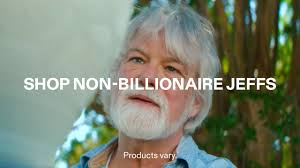
Every once in a while, a commercial comes along that does not need a dissertation, a celebrity cameo, or a thirty-second brand manifesto to make its point.
It just needs a good joke, perfect timing, and one painfully obvious cultural truth.
That is exactly what Etsy pulled off with its “Shop Other Jeffs” campaign.
At first glance, the idea is funny because it is so simple. Instead of pointing shoppers toward one very famous billionaire Jeff, Etsy reminds people that there are thousands of other Jeffs out there — regular people, independent makers, craftspeople, artists, woodworkers, potters, designers, and small business owners — creating real things with real human hands.
The message is playful, but it lands because it is not just a joke.
It is a brand argument.
Etsy is not trying to beat Amazon at being Amazon. It is not promising the fastest box, the biggest warehouse, or the loudest deal countdown. Instead, Etsy is reminding people that shopping can still feel personal. It can still feel connected. It can still feel like there is a person on the other side of the order.
And in 2026, that may be one of the smartest marketing messages a company can make.
The Joke Is Simple — and That Is Why It Works
The best advertising ideas are usually the ones you understand instantly.
“One Jeff should not rule commerce.”
That line does a lot of work.
It makes people laugh. It points directly at the elephant-sized cardboard box in the room. It creates a memorable contrast between giant corporate retail and independent creative sellers. And it does all of that without turning the ad into a bitter attack.
That is the magic of the campaign.
Etsy does not need to name Amazon directly for people to understand the joke. The cultural reference is obvious enough. Everyone knows the Jeff being implied. Everyone knows the scale of Amazon. Everyone knows what Prime Day represents: speed, deals, convenience, urgency, and a whole lot of impulse buying.
So Etsy zagged.
Instead of saying, “We also have deals,” it said, “Maybe shop from a human.”
That is a much stronger position.
Etsy Picked the Perfect Moment
Timing matters in marketing, and Etsy’s timing here is razor sharp.
Amazon Prime Day is one of the biggest shopping events on the calendar. For days, the internet becomes a giant flashing sale sign. Every website, inbox, influencer feed, and product page seems to join the chorus: hurry, click, buy, repeat.
Etsy’s campaign steps into that noise and says something totally different.
It does not try to out-discount Amazon. It does not try to out-convenience Amazon. It does not even pretend to be playing the same game.
Instead, Etsy reframes the conversation.
Prime Day says, “Look how fast and cheap this can be.”
Etsy says, “Look who made it.”
That difference is everything.
Because when everyone else is screaming about price and speed, a message about people suddenly feels refreshing. It feels almost rebellious. It reminds shoppers that a purchase can be more than a transaction. It can be a tiny vote for the kind of marketplace they want to support.
This Is Challenger Branding Done Right
There is a fine line between clever challenger branding and cheap dunking.
Etsy stays on the right side of that line.
The campaign is cheeky, yes. It is clearly poking at Amazon, yes. But the heart of the campaign is not really about tearing another company down. It is about lifting Etsy’s own sellers up.
That is why the “Jeffs” angle works so well.
The joke gets your attention, but the sellers give it meaning.
By spotlighting real independent sellers named Jeff, Etsy turns a clever marketing stunt into a human story. These are not anonymous storefronts buried under endless product listings. They are people with skills, shops, workshops, histories, and creative fingerprints.
That is where the campaign earns its emotional weight.
A weaker version of this ad would have simply made fun of billionaires. A stronger version, which is what Etsy did, uses the joke as the doorway into something more meaningful.
It says: yes, this is funny — but also, these people are real.
The Real Product Is Not Just the Product
One of the smartest things Etsy understands is that people do not only buy objects.
They buy stories.
They buy personality. They buy taste. They buy the feeling of finding something that does not look like it came from the same algorithmic conveyor belt as everything else. They buy the little thrill of knowing someone actually made, selected, packed, customized, painted, stitched, carved, printed, or designed the thing they are receiving.
That is hard for a giant retailer to replicate.
A warehouse can be efficient. An algorithm can be accurate. A delivery network can be astonishingly fast.
But none of those things feel like a person.
That is Etsy’s lane.
The “Shop Other Jeffs” campaign works because it reminds people what Etsy is really selling: not just mugs, signs, jewelry, furniture, cards, art, shirts, decor, or handmade gifts.
Etsy is selling the human fingerprint.
Why This Hits Harder in the Age of AI
The timing of this campaign also feels bigger than Prime Day.
We are living in a moment where everything is becoming automated, optimized, recommended, generated, personalized, and delivered before we have even fully decided whether we wanted it in the first place.
That is convenient.
It is also exhausting.
The more digital life becomes, the more people seem to crave something that feels grounded. Handmade. Human. Imperfect in a good way. Personal in a way that cannot be mass-produced.
That is why Etsy’s broader “Celebrate Being Human” message feels so smart.
It taps into something that is already happening culturally. People are not just asking, “What can I buy?” They are asking, “Who am I supporting?” “Where did this come from?” “Does this feel like me?” “Does this feel real?”
That matters for Etsy.
It also matters for creators, podcasters, voice actors, authors, musicians, designers, artists, and anyone trying to build a small brand in a giant algorithmic world.
The future may be automated, but trust is still human.
What Creators Can Learn From Etsy’s Jeff Campaign
This is not just a good commercial. It is a useful lesson for small creators.
The lesson is not “take shots at Amazon.”
The lesson is this: know what the giant cannot own.
Amazon can own speed. It can own scale. It can own convenience. It can own logistics. It can own the feeling of “I need this by tomorrow.”
But Etsy can own human creativity.
That is the lesson.
For independent creators, this is huge. You do not have to beat the biggest player at their own game. In fact, trying to do that may be the fastest way to disappear.
A small podcast does not need to sound like a giant network.
An indie author does not need to pretend to be a major publishing house.
A voice actor does not need to market themselves like a faceless production company.
A local artist does not need to compete with mass-produced wall art.
The advantage is the human element.
Your story. Your taste. Your process. Your sense of humor. Your point of view. Your reason for making the thing in the first place.
That is what people connect with.
Etsy’s campaign works because it does not hide behind corporate polish. It uses the platform’s biggest advantage — real people making real things — and turns that advantage into a joke everyone can understand.
That is great marketing.
The Best Marketing Feels Obvious After Someone Else Does It
Part of what makes “Shop Other Jeffs” so good is that it feels obvious after you see it.
Of course Etsy should say this.
Of course the timing should be right before Prime Day.
Of course the joke should revolve around Jeff.
Of course the sellers should be real.
Of course the message should be human.
But that is the thing about great marketing. It often feels simple after the fact because the strategy is clean. The insight is sharp. The execution does not get in its own way.
Etsy did not overcomplicate it.
They found the cultural moment, located the emotional contrast, added one perfect joke, and brought it back to the people who make the platform worth visiting in the first place.
That is how you create a campaign people want to talk about.
Not because they were forced to watch it.
Because they instantly got it.
The Human Touch Is Still the Best Strategy
The genius of Etsy’s “Shop Other Jeffs” campaign is not just that it is funny.
It is that the joke points to something true.
People are tired of feeling like every purchase, post, search result, recommendation, and checkout page is part of one giant machine. Convenience is wonderful, but it is not the same thing as connection.
Etsy saw the opening and walked right through it.
In a shopping season dominated by speed, scale, and billionaire-powered commerce, Etsy reminded people that there are still regular humans out there making things worth buying.
Jeffs, apparently, included.
And maybe that is the bigger takeaway.
The internet may keep getting bigger, faster, louder, and more automated.
But the human touch still cuts through.
Sometimes all it takes is one great idea.
Or in Etsy’s case, more than 5,000 Jeffs.
About the Author
John Bowman is the creator and host of On Air with Johnny B, a veteran-owned media project covering entertainment, creativity, voiceover, music, marketing, and the human stories behind the work. Through Milspec Digital, John writes about the intersection of pop culture, independent creators, storytelling, and the moments that make people stop scrolling.